
Union County Warrant Records
Union County publishes its main online warrant channel through the official Sheriff P2C Wanted List. The list is not a complete criminal case file. It is a wanted-record tool that displays people or papers the listed agency has made public through P2C. Entries can include arrest warrants, orders for arrest after failure to appear, orders to show cause, civil orders for arrest, and drivers license pickup orders.
The Sheriff P2C page is useful because it identifies the paper type and agency. That matters in Union County, where a wanted entry may come from the Union County Sheriff's Office, a municipal police agency such as Waxhaw Police Department, or a court matter maintained by the Clerk of Superior Court. Once a person is arrested on a warrant, magistrate and jail channels become important for initial appearance, bond, and custody questions.
The official Union County P2C wanted-list screenshot source shows the public warrant list layout used for name, charge, paper type, and agency fields.
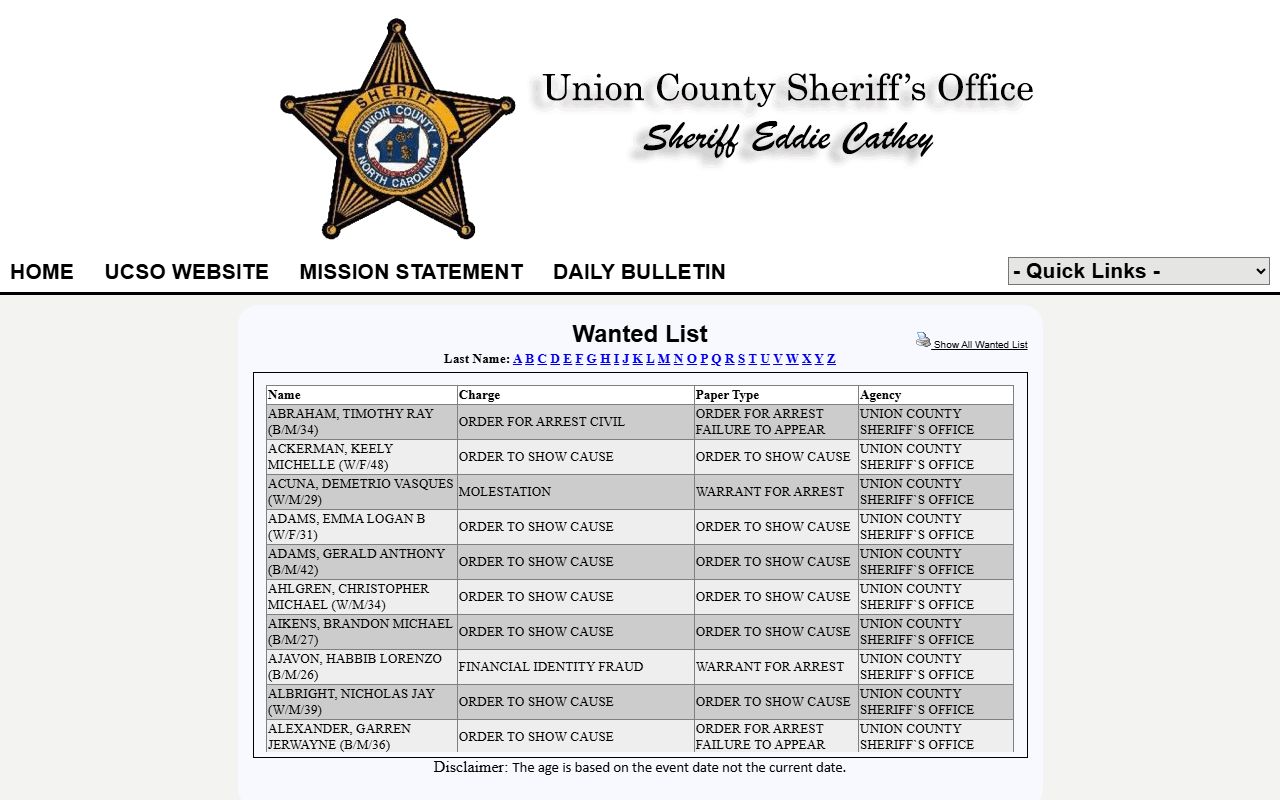
The P2C image supports the main online access point, but official follow-up still depends on the paper type, agency, court file, and current custody status.
Union County Warrant Types
Union County warrant records use several paper labels. A warrant for arrest can be tied to a new criminal allegation or an existing court matter. An order for arrest is often connected to failure to appear or other court noncompliance. An order to show cause directs a person to answer a court issue, and a civil order for arrest can arise in limited civil or support contexts. A drivers license pickup order is a separate paper type shown in the P2C sample inventory.
- Warrant for arrest - judicial process authorizing arrest on a charge or qualifying court matter.
- Order for arrest failure to appear - court paper commonly linked to a missed court date.
- Order to show cause - paper requiring a person to answer why the court should not take a requested action.
- Civil order for arrest - civil court process that may appear in limited noncriminal enforcement matters.
- Drivers license pickup order - listed paper type that should be checked with the issuing agency or clerk.
Search warrants are different. Returned search warrant materials may become public under public-record rules in some contexts, but active investigative records can be restricted. For law enforcement investigative material, G.S. 132-1.4 limits access to criminal investigation and intelligence records.
Search Union County Warrants
The fastest public warrant search path is the Sheriff P2C Wanted List. Use the alphabet filter when the last name is known, or use Show All Wanted List when a broader scan is needed. Confirm the paper type before taking action. A public wanted-list record can be stale, incomplete, or limited by agency posting rules, so a serious warrant issue should be checked through official phone or court channels as well.
- Open the official Union County Sheriff P2C Wanted List.
- Select the first letter of the last name, or choose Show All Wanted List.
- Read the name, charge, paper type, and agency fields together.
- For a related criminal or traffic case, search the North Carolina eCourts Portal by name or case number.
- Call the Sheriff, Clerk of Superior Court, or magistrates for the official next step when the entry may affect arrest, bond, or a court date.
Portal is not a real-time active warrant clearance system. It helps locate the underlying court case, hearing, disposition, or failure-to-appear issue, while P2C shows public wanted entries posted by law enforcement.
Union County Warrant Search Fields
The P2C wanted-list search is simple, but the result columns carry the key facts needed for follow-up. The age shown in public entries is based on the event date, not the current date, so do not treat it as a current age calculation.
| Field Label | Type | Required | Options / Format Notes |
|---|---|---|---|
| Last Name | alphabet filter | optional | A-Z letter links. |
| Show All Wanted List | link/button | optional | Returns all listed wanted entries. |
| Name | result column | n/a | Name with demographic shorthand. |
| Charge | result column | n/a | Offense or order reason. |
| Paper Type | result column | n/a | Warrant for Arrest, Order to Show Cause, Order for Arrest Failure to Appear, Civil Order for Arrest, Drivers License Pickup Order, and related paper labels. |
| Agency | result column | n/a | Issuing or holding agency. |
Union County Warrant Fields
A Union County warrant record in P2C does not show every case document. It gives a public wanted-list snapshot. The full court file may later show case number, bond or pretrial release terms, hearings, plea, disposition, sentence, or dismissal. For those case details, use the Clerk of Superior Court and eCourts case tools.
| Field | What It Shows |
|---|---|
| Name | The listed person's name with demographic shorthand and an event-date age note. |
| Charge | The offense, support issue, show-cause reason, or wanted-paper description. |
| Paper Type | The legal paper category, such as warrant for arrest or order for arrest failure to appear. |
| Agency | The law enforcement agency connected to the wanted entry. |
| Related Case | Not always shown in P2C; use Portal or the clerk when a court case is involved. |
The Union County Public Defender page confirms Defender District 30 and names the local public defender office, which may matter for people with appointed counsel in a criminal warrant case.
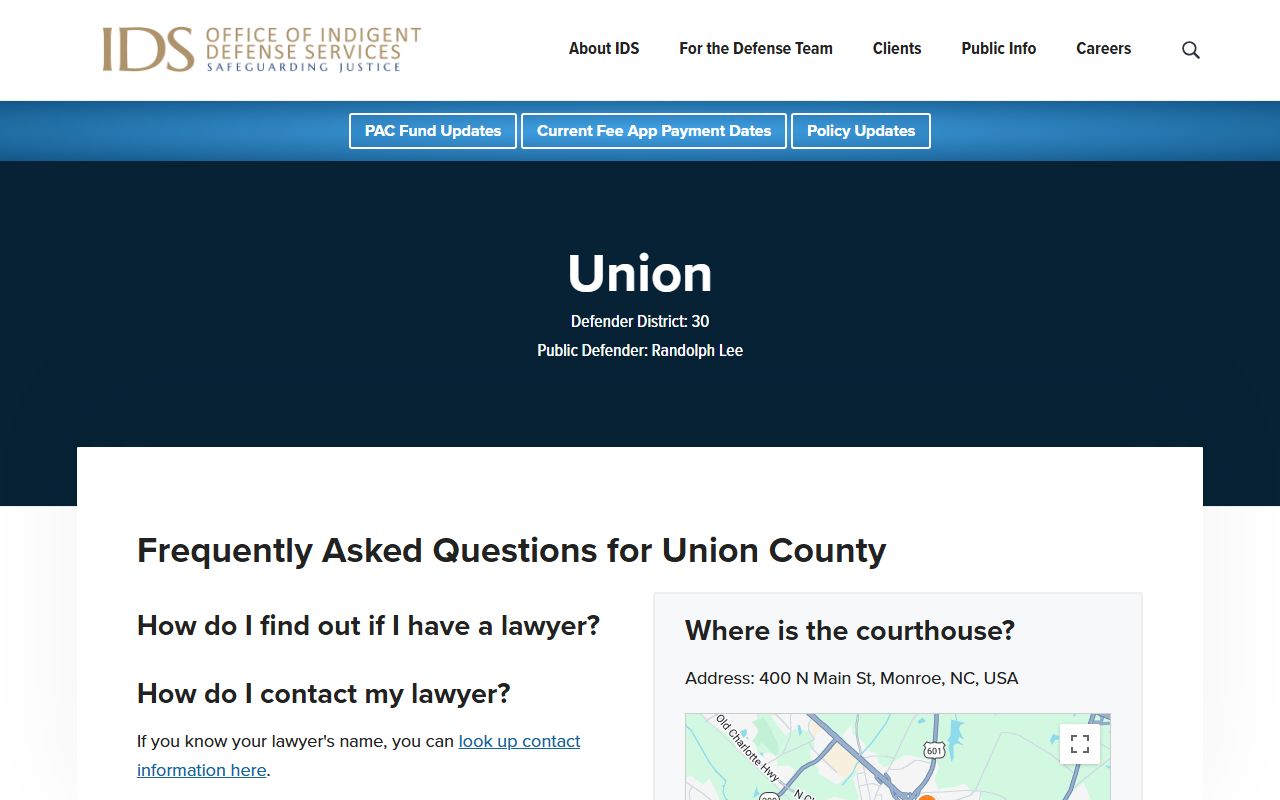
Defense contact information is not a warrant search result, but it is part of the official court path when a warrant is tied to a pending criminal case.
Union County Warrant Contacts
Use every documented access channel when a Union County warrant search may affect arrest or court appearance. Sheriff P2C is the public online start. The Sheriff's Office main number is 704.283.3789, and the jail number is 704.292.2600 for custody and booking questions. The Clerk of Superior Court can help with court-file questions at (704) 698-3100. Magistrates at (704) 292-2746 handle initial appearance and bond questions after arrest.
Failure-to-appear warrants, contempt papers, orders to show cause, child-support papers, and drivers license pickup orders often require court file review. The Union County court contact directory lists the local court offices, including Clerk of Superior Court, District Attorney, magistrates, and other court divisions. For a charge pending in court, the related criminal case details belong in the Union County criminal court record, not only in the P2C wanted list.
Note: Do not rely on unofficial warrant sites for clearance, surrender, bond, or court-date decisions.
Resolve Union County Warrants
Resolving an outstanding warrant starts with confirming the paper type and agency. A person listed on P2C should compare the wanted entry with the related court case in Portal when a case exists. For failure to appear, payment, compliance, or missed hearing questions, contact the Clerk of Superior Court or the appropriate court office. For custody and surrender logistics, contact the Sheriff's Office or jail. For bond and first appearance questions after arrest, magistrate information may be needed.
- Confirm the exact name, charge, paper type, and agency from P2C or an official call.
- Search Portal for the underlying case when the warrant came from a court matter.
- Ask the clerk or court office what action is required to address the case issue.
- Consult an attorney before voluntary surrender when arrest or bond is likely.
- Keep receipts, release papers, compliance orders, and future court-date notices.
Important: A wanted-list entry can lead to arrest, so legal advice should come before surrender or case negotiation.
Restricted Union County Warrants
Not every warrant or warrant-related document is public. Active investigative records can be limited under G.S. 132-1.4. Juvenile court records are restricted under G.S. 7B-3000. Sealed matters, sensitive victim information, and some returned search-warrant materials may require court review rather than ordinary public search.
The N.C. defender directory source is useful when a warrant is tied to an appointed-counsel criminal case in Defender District 30.
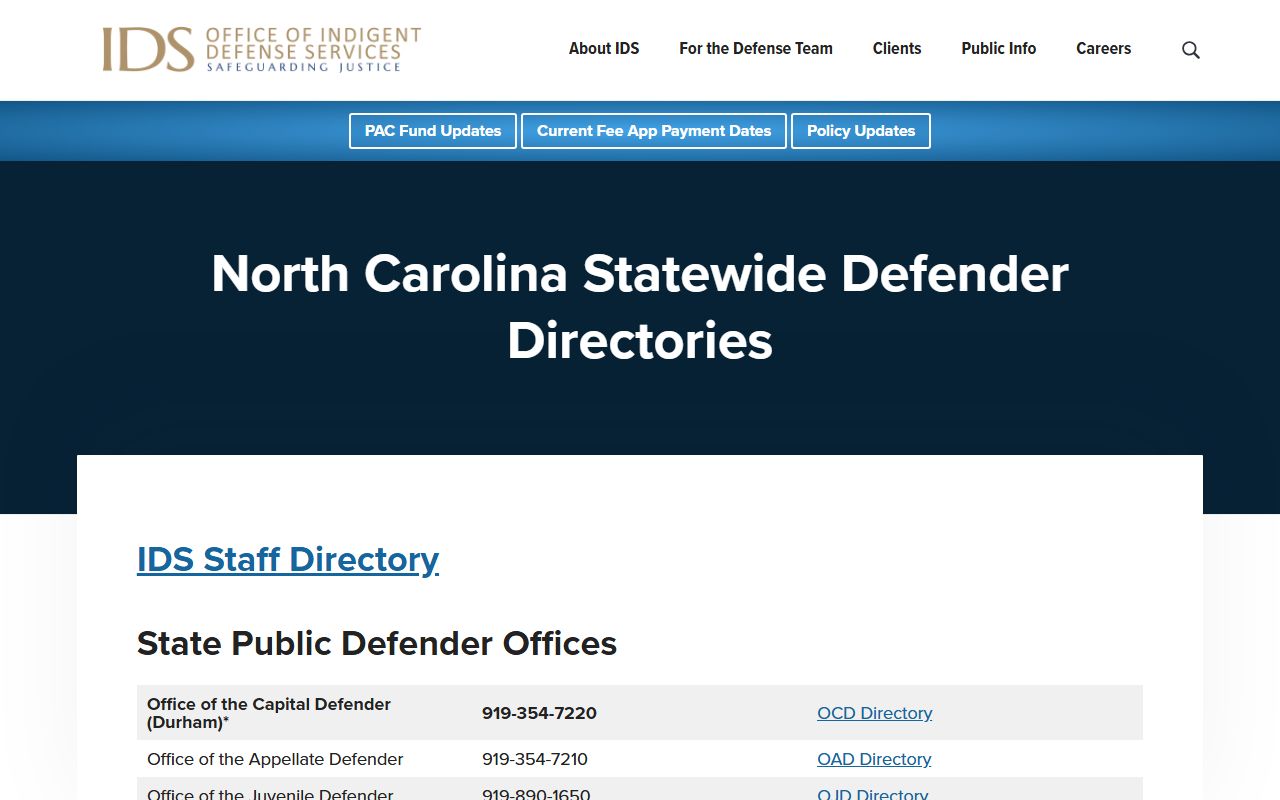
Restricted records do not disappear from all official systems; they are simply not available through the same public search path as ordinary wanted-list entries.