
How to Search Union County Court Records
The main online path for Union County Court records is North Carolina eCourts Portal. The Portal home includes Smart Search, Search Hearings, Make Payments, and NC Judgment Search. Smart Search is used for case information. Search Hearings is used for hearing dates and courtroom settings. NC Judgment Search is used for judgment index entries, with complete case summary details reached through Smart Search.
Because Portal is statewide, Union County searches should use the county location filter when available. For older files, certified copies, paper pleadings, divorce judgments, estates, special proceedings, or incomplete online entries, the Clerk of Superior Court remains the county contact. The N.C. Judicial Branch also says public self-service terminals at clerk offices can be used for criminal, civil, special proceeding, and estates information.
- Start at eCourts Portal or the Union County Judicial Branch page.
- Choose Smart Search for case records, Search Hearings for calendar details, or NC Judgment Search for judgment index entries.
- Enter a record number or a party name in Last, First Middle Suffix format.
- Filter by Union County, case type, status, and filing-date range when those fields apply.
- Use wildcard rules carefully, since Portal training gives minimum character rules for names and case numbers.
- Contact the Clerk of Superior Court for certified copies, paper files, and records not visible online.
The Portal source is the statewide entry point for Union County case searches.
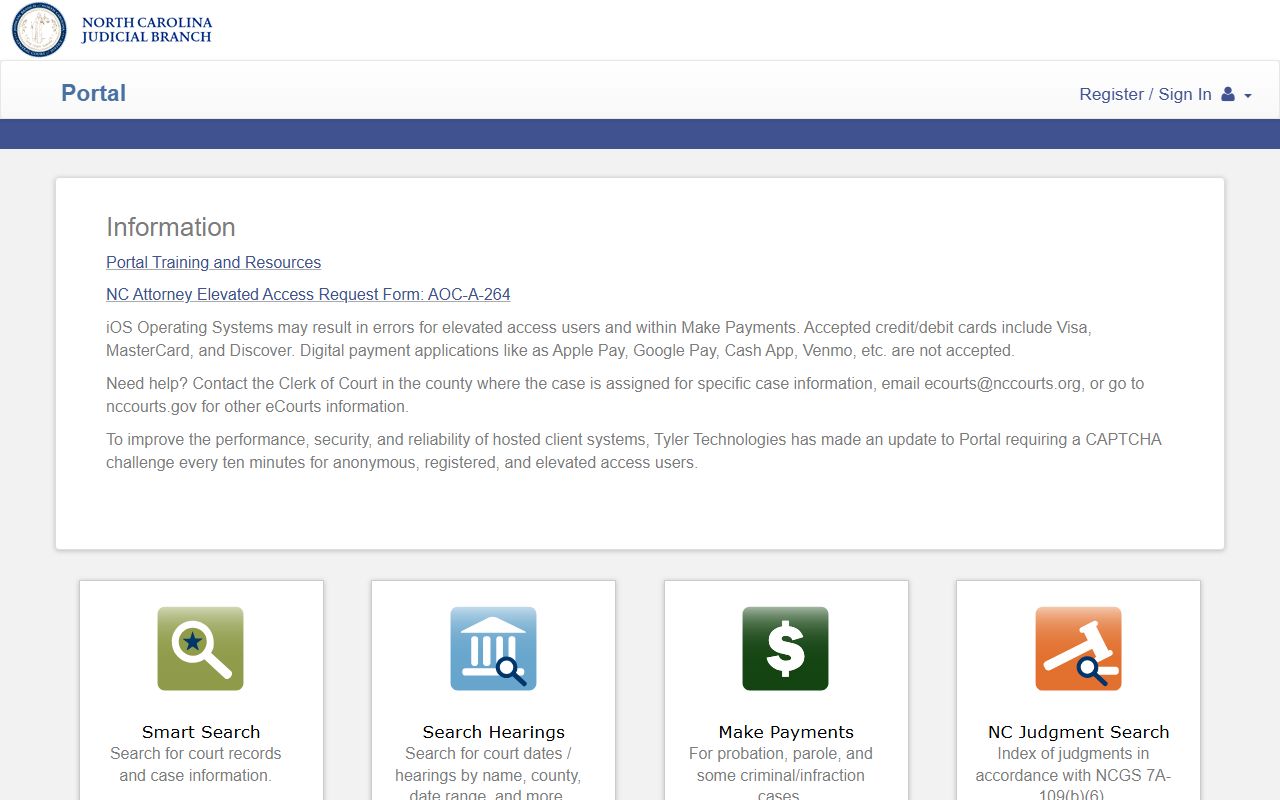
Using the statewide Portal with a Union County filter keeps local cases separate from results in other North Carolina counties.
Union County Judicial Center
The main courthouse for Union County state-court business is the Union County Judicial Center in Monroe. It houses the Clerk of Superior Court and local Superior Court and District Court functions. The N.C. Judicial Branch location page gives the courthouse address, mailing address, main phone, hours, a courthouse photo, and directions. It is the correct destination for court dates, paper-file requests, divorce judgment copy requests, jury service, and clerk counter records.
Other official record offices are close by but serve different purposes. The Register of Deeds is at the Union County Government Center and handles deeds, marriage certificates, marriage licenses, birth and death records, notary records, and related county records. The Sheriff's Office and jail are on Presson Road and handle custody, booking, wanted-list, and law-enforcement records. Sending a request to the wrong office can slow down a Union County Court records search.
Union County Judicial Center
400 North Main Street
Monroe, NC 28112
(704) 698-3100
Monday-Friday, 8:30 a.m.-5:00 p.m.
Register of Deeds
500 North Main Street, Suite 258
Monroe, NC 28112
704-283-3843
Marriage and recorded county records
Union County Jail
3344 Presson Road
Monroe, NC 28112
(704) 283-3641
Custody and detention records
The official Union County Judicial Center source confirms the main courthouse location and court contact point.
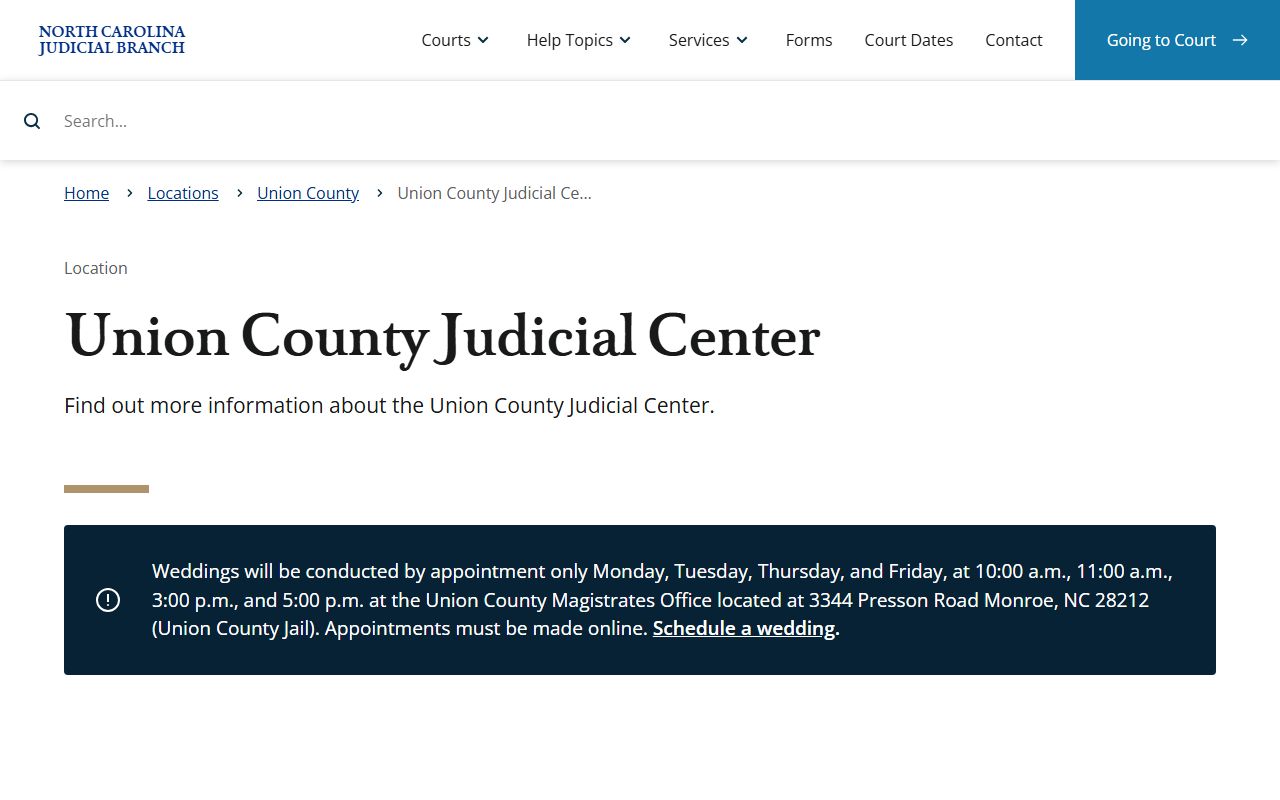
That distinction helps direct court records to the Judicial Center instead of the jail or Register of Deeds office.
The official Union County court contact directory lists the local court offices tied to clerk, judge, magistrate, district attorney, family court, arbitration, and drug court questions.
That directory helps route Union County Court records questions to the office that actually maintains or schedules the record.
Union County Court Structure
North Carolina uses a unified state court system. The trial level is divided between Superior Court and District Court. Union County is officially listed as Prosecutorial District 30, Superior Court District 30, and District Court District 30. The Clerk of Superior Court maintains court files for both Superior Court and District Court in the county. Probate is not a separate county probate court; estates and special proceedings route through the clerk's estates and special proceedings functions.
| Court or Office | Role in Union County | Record Relevance |
|---|---|---|
| Superior Court District 30 | Felony criminal, major civil, jury trials, and certain appeals or transfers | Criminal case files, civil files, judgments, and trial records |
| District Court District 30 | Misdemeanors, infractions, traffic, domestic, juvenile, small claims appeals, and magistrate matters | Traffic, misdemeanor, family, juvenile, small claims, and civil records |
| Magistrates | Initial appearances, pretrial release, small claims, summary ejectment first stages, and ceremonies | Bond, first appearance, small claims, and related docket entries |
| Clerk of Superior Court | Court files, terminals, copies, estates, divorce judgments, and special proceedings | Main custodian for Union County state court records |
Case flow: Magistrate or District Court function › District Court or Superior Court case › North Carolina Court of Appeals where review is available › Supreme Court of North Carolina in selected matters.
The Union County Judicial Branch landing page lists local district information and links to court dates, calendars, forms, services, and official local pages.
That page is the best official starting point for local court status, services, and Union County-specific links.
Union County Court Record Types
Union County Court records include criminal, civil, family, traffic, special proceeding, estates, judgment, and docket information. Criminal records can include misdemeanor, felony, infraction, probation violation, bond, plea, judgment, sentence, and disposition information. Civil records include lawsuits, small claims, summary ejectment, money judgments, liens, domestic civil filings, and other civil actions. Family court records can include divorce, equitable distribution, custody, support, protective orders, and local forms.
Some record types are related but not the same. Sheriff P2C records can show inmate custody, arrest charges, wanted-list entries, and daily bulletin events. Those records help identify an arrest or wanted paper, but the court file later shows formal charging documents, hearings, pleas, orders, dispositions, and sentence terms. Marriage licenses and certificates are Register of Deeds records. Divorce judgments are court records from the clerk in the county where the divorce was granted.
- Court records: case summaries, filings, dockets, orders, judgments, and copies.
- Criminal court records: charges as filed, case events, pleas, dispositions, sentencing, and probation conditions.
- Court dockets: hearing dates, event history, courtroom settings, and schedule details.
- Traffic records: citations, infractions, hearings, payment eligibility, and court outcomes.
- Estates records: wills, probate administration, guardianship, and special proceedings through the clerk.
What Union County Court Records Show
A public case summary may show case number, party names, case type, case status, filing date, hearings, disposition status, and judgment index information. Full paper files may contain pleadings, motions, orders, judgments, notices, service returns, financial obligations, bond and pretrial release papers, probation orders, courtroom minutes, and document copies not exposed in an online result.
| Field | What It Means |
|---|---|
| Case Number | The unique identifier used in Portal, clerk terminals, hearing searches, and copy requests. |
| Parties | Defendants, plaintiffs, petitioners, respondents, attorneys, or other named case participants. |
| Case Type | The court category, such as criminal, civil, domestic, estates, small claims, or traffic. |
| Docket Events | Filings, hearings, continuances, motions, orders, pleas, or other case actions. |
| Disposition | The outcome, judgment, dismissal, conviction, sentence, or final case status when public. |
- Docket
- A chronological list of court events or scheduled hearings.
- Judgment
- A final or enforceable court decision, often including money, custody, conviction, or sentence terms.
- Expunction
- A statutory process that removes certain eligible records from public access.
Union County Court Public Access
North Carolina access rules combine court-record law, public-record law, and confidentiality statutes. G.S. 7A-109 says clerks maintain records, files, dockets, and indexes and that those records are open for public inspection during regular office hours unless law restricts them. G.S. 132-1 defines public records broadly, while G.S. 132-6 addresses inspection and copies.
Key access rule: Public access does not mean every Union County Court document is online or free to copy.
G.S. 132-1.4 limits criminal investigation and intelligence records, even when a related case or P2C entry is public.
G.S. 7B-3000 governs juvenile court records and supports restricted treatment for juvenile files.
The official obtaining court records source explains public terminals, clerk paper files, and copy channels.
That source supports using Portal for public summaries and the clerk for files, certified copies, and records not available online.
Restricted Union County Records
Restricted records include juvenile court records, sealed and expunged files, adoption records, certain mental health proceedings, personal identifiers, protected addresses, confidential victim information, and active criminal investigation materials. Law-enforcement recordings also use a special disclosure process and should not be routed through ordinary court case search.
Expunctions are handled through North Carolina statutes and Judicial Branch procedures. A person seeking to clear a Union County criminal record should identify the charge, case number, county, and disposition, then compare the case to the applicable expunction help topic and statute. Petitions are filed with the Clerk of Superior Court in the county of the case.
Union County Sheriff and Jail Records
The Union County Sheriff's Office maintains custody and law-enforcement records that are related to court cases but separate from court files. Sheriff P2C Inmate Inquiry shows current jail roster information. P2C Wanted List shows active wanted entries. P2C Daily Bulletin can show arrests, citations or summonses, incidents, and ordinance violations. The jail and Sheriff's Office are on Presson Road, not at the Judicial Center.
Jail records answer custody and booking questions. Court records answer case and disposition questions. For county jail custody, use Sheriff P2C or jail contacts. For state prison, probation, or parole records, use the N.C. Department of Adult Correction offender search. For victim notification, North Carolina VINE is the documented statewide notification channel.
| Channel | What it shows | Source |
|---|---|---|
| Sheriff P2C Inmate Inquiry | Name, primary charge, arrest date, booking agency, and detail links | Inmate Inquiry |
| Sheriff P2C Wanted List | Name, charge, paper type, and agency | Wanted List |
| Sheriff P2C Daily Bulletin | Arrests, citations, incidents, and ordinance events | Daily Bulletin |
Union County Warrants and Payments
The Sheriff P2C Wanted List is the main official online warrant and wanted-list channel documented in the research. It uses an alphabet filter and a Show All Wanted List control. Result columns include name, charge, paper type, and agency. Sample paper types include warrant for arrest, order to show cause, order for arrest failure to appear, civil order for arrest, and drivers license pickup order.
Court payments have their own channels. Union County payment guidance says mail payments use money order or certified check only, no cash and no personal checks by mail. Payments are made payable to Union County Clerk of Superior Court and mailed to the clerk at the Judicial Center post office box. In-person payments at the cashier's office accept cash, credit or debit card with processing fees, money order, and certified check. Online payment uses eligible court services.
Marriage Divorce and Estates
Marriage licenses and marriage certificates are Union County Register of Deeds records. Divorce judgments are court records from the Clerk of Superior Court in the county where the divorce was granted. The Register of Deeds FAQ specifically routes Union County divorce copies to the Clerk of Courts office. That split is important because marriage and divorce records do not come from one office in North Carolina.
Estates, wills, guardianships, and many special proceedings are handled through the Clerk of Superior Court's estates and special proceedings functions. A will may have been deposited for safekeeping with a clerk before death, and if a decedent lived in more than one North Carolina county, prior counties of residence can matter. Public terminals and Smart Search may help with nonconfidential estates, while paper files and copies route to the Union County clerk.
Union County Local Rules
Union County local rules and forms are heavily family-court oriented. The local forms list includes domestic cover sheets, financial affidavits, child custody pro se packets, requests for setting, custody mediation forms, equitable distribution forms, motions to continue, administrative discovery orders, mediation waiver forms, status conference materials, temporary restraining order forms, and consultation verifications. Those forms can appear in docket and case-file research for domestic and family matters.
The local rules and forms source is the official place to confirm what Union County publishes for local court practice.
Those forms help explain why a family or domestic docket may contain local form names that do not appear in a general criminal or traffic case.
Jury Service and eCourts Updates
Union County jury service has useful courthouse details. Jurors report to Room 2018 at the Judicial Center. The jury information line is (704) 698-3105, and questions before service use (704) 698-3269. Jurors may bring drinks but should tell the deputy at the security station they are present for jury service. Excusal or deferral requests must be received at least ten days before the service date and are not handled by phone.
The modern records path changed with eCourts. Judicial Branch news says eCourts went live in Union County as part of the Southern and Central Piedmont rollout announced October 14, 2024. The Union County court page also listed June 10, 2025 news about eCourts kiosks with scanners, printers, and payment services deploying to courthouses including Union County.
The official Union County jury service source gives reporting details and local jury contacts.
Jury details are not a records search tool, but they confirm courthouse entry, security, and local court operations at the Judicial Center.
The eCourts rollout news source documents the move to online case search, hearings, records, documents, and payments.
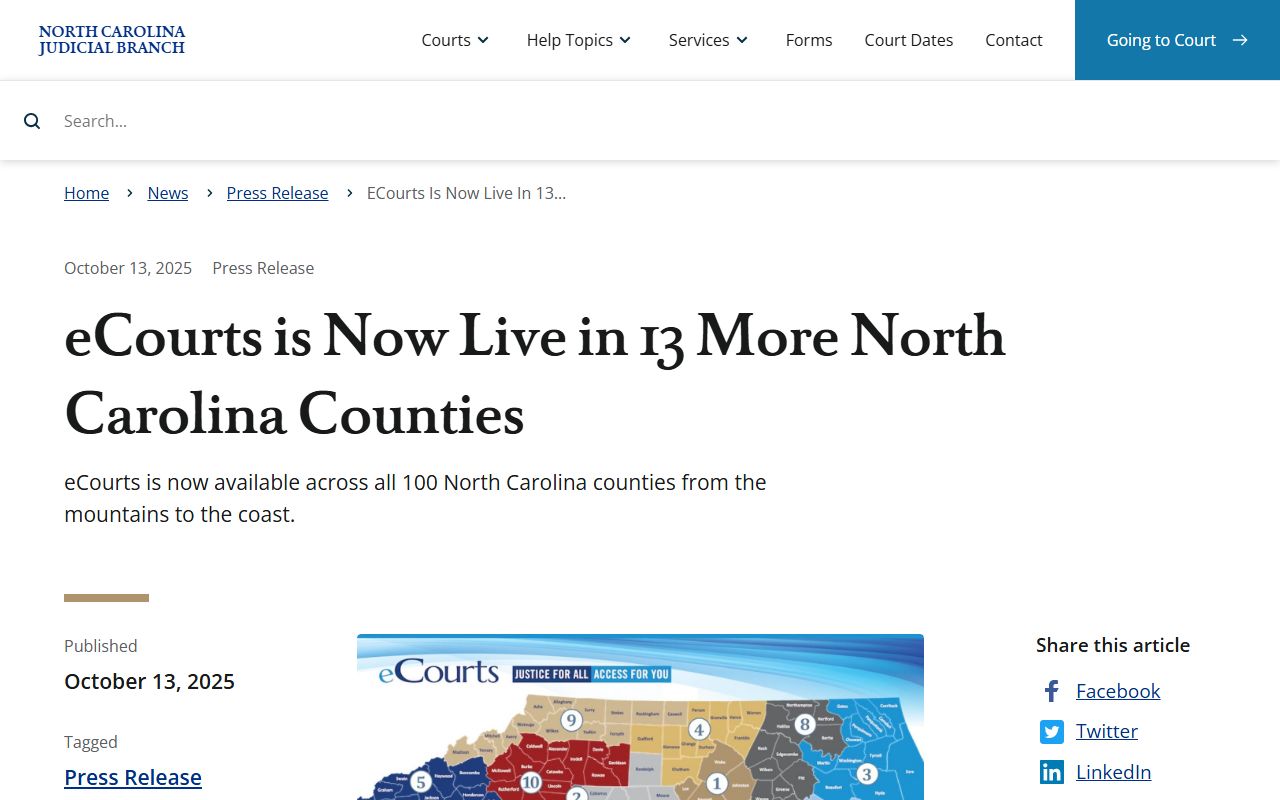
That rollout explains why Union County Court records research now depends on both Portal access and in-person clerk workflows.
Union County Court Records FAQ
Where are Union County Court records kept? State court records are maintained through the Clerk of Superior Court at the Union County Judicial Center. Online case summaries may be searched through eCourts Portal, but paper files, certified copies, older records, and many copy questions route to the clerk in Monroe.
Are all Union County Court records online? No. Portal, Search Hearings, and NC Judgment Search provide public online access to selected case and hearing information. Some files require a public terminal, clerk review, copy request, or paper file request. Restricted records may not be public at all.
Who handles divorce records in Union County? Divorce judgments are court records held by the Clerk of Superior Court in the county where the divorce was granted. Marriage licenses and certificates are handled by the Union County Register of Deeds, which is a different office.
How are warrants different from criminal court records? A warrant or wanted-list entry may show a paper type, charge, and agency. The criminal court record later shows the case number, hearings, plea, disposition, sentence, dismissal, or other court action. Both may be needed for a full picture.